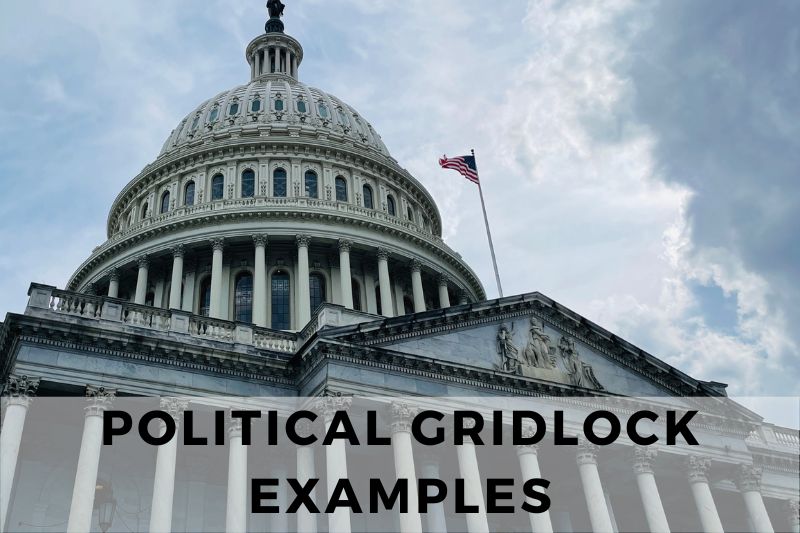
Political gridlock is a phenomenon that occurs when opposing parties or factions in a governing body fail to reach agreements on policy decisions, leading to legislative paralysis. This impasse often results from deep ideological differences, competing priorities, or an unwillingness to compromise. While political gridlock can be frustrating for citizens and policymakers alike, it is also an inherent feature of democratic systems that encourage debate and dissent. Throughout history and in modern times, political gridlock has shaped critical events and decisions, influencing societies on a local, national, and global scale.
This article explores notable examples of political gridlock, categorized into three key areas: historical instances, modern occurrences within U.S. politics, and global cases. By examining these examples, we gain insight into the causes and consequences of gridlock and its enduring impact on governance and public policy.
What Is Political Gridlock?
Political gridlock, often called legislative stalemate or deadlock, occurs when decision-making in a government is obstructed due to conflicting interests among political parties, factions, or leaders. This impasse often results from ideological differences, competing priorities, or a refusal to compromise. It can prevent the passage of laws, stall policy reforms, or delay essential government functions. While many view gridlock as a failure of governance, others argue it serves as a safeguard against unchecked power, reflecting the diversity of opinions in democratic systems.
In systems with separated powers, such as the United States, gridlock is common during periods of divided government when the executive and legislative branches are controlled by opposing parties. Globally, coalition governments and multiparty systems face similar challenges when consensus cannot be reached. Although frustrating, political gridlock underscores the importance of debate and negotiation in balancing power and ensuring that decisions represent a broad spectrum of perspectives.
Historical Examples of Political Gridlock
Throughout history, political gridlock has emerged during some of the most pivotal moments in governance, often delaying critical decisions or reshaping the course of nations. These historical examples highlight the complexities and consequences of legislative stalemates.
#1. The Nullification Crisis (1832-1833)
The Nullification Crisis was a confrontation between federal and state powers over tariff laws. South Carolina, led by John C. Calhoun, declared the federal tariffs of 1828 and 1832 unconstitutional, asserting its right to nullify federal laws. This defiance led to a tense standoff with President Andrew Jackson, who sought Congressional authority to enforce the tariffs through the Force Bill.
The gridlock ended with a compromise tariff in 1833, brokered by Henry Clay, which gradually reduced tariff rates and avoided further escalation. This crisis highlighted the tensions between state sovereignty and federal authority, serving as an early warning of the conflicts that would later ignite the Civil War.
#2. The Missouri Compromise (1820)
The Missouri Compromise was a legislative agreement intended to address the divisive issue of slavery’s expansion. As Missouri sought admission to the Union as a slave state, debates raged in Congress, with Northern and Southern legislators at an impasse over maintaining the balance of power between free and slave states.
A compromise, orchestrated by Henry Clay, admitted Missouri as a slave state and Maine as a free state, while establishing the 36°30′ line to limit slavery in future territories. While the compromise temporarily alleviated tensions, it exposed the nation’s deepening sectional divides over slavery.
#3. The Civil Rights Era (1950s-1960s)
The Civil Rights Movement faced significant legislative gridlock as lawmakers clashed over measures to dismantle segregation and protect voting rights for African Americans. Southern senators, employing tactics like filibusters, stalled progress on key legislation for years.
Despite the resistance, landmark achievements like the Civil Rights Act of 1964 and the Voting Rights Act of 1965 eventually passed, thanks to persistent advocacy, public pressure, and bipartisan cooperation. These legislative battles underscored the enduring struggle to overcome systemic inequality in the United States.
#4. Reconstruction Era Deadlock (1865-1877)
After the Civil War, the Reconstruction Era was fraught with political gridlock between President Andrew Johnson and Congress. Johnson’s lenient approach to rebuilding the South clashed with Congressional Republicans’ push for stricter measures to protect newly freed African Americans and reshape Southern governance.
This conflict led to numerous vetoes, overridden bills, and even Johnson’s impeachment attempt. The stalemate hindered the effective implementation of Reconstruction policies, leaving many issues unresolved and contributing to the eventual rise of Jim Crow laws.
#5. The New Deal Opposition (1930s)
During the Great Depression, President Franklin D. Roosevelt’s New Deal programs faced staunch opposition from conservatives in Congress and the judiciary. Critics argued that the expansive government initiatives overstepped constitutional limits and threatened free-market principles.
The political gridlock forced Roosevelt to adapt his strategies, including an attempt to reorganize the Supreme Court to secure favorable rulings. While the New Deal achieved significant reforms, the clashes underscored the ideological divides over the role of government during economic crises.
#6. The Vietnam War Funding Debates (1960s-1970s)
The Vietnam War became a major source of political gridlock as public opinion shifted against the conflict. Congressional debates over funding the war and limiting presidential military authority led to heated clashes between lawmakers and the executive branch.
The passage of the War Powers Act in 1973, intended to curtail presidential authority to engage in armed conflicts without Congressional approval, marked a turning point. However, the prolonged gridlock during the war highlighted the challenges of balancing executive power with legislative oversight.
#7. The 19th Amendment Ratification (1919-1920)
The fight for women’s suffrage was marked by decades of political stalemate, with repeated failures to secure the necessary votes for a constitutional amendment. Intense lobbying and grassroots activism gradually shifted public opinion, pressuring Congress to act.
In 1919, the 19th Amendment passed Congress, granting women the right to vote. However, its ratification required a hard-fought state-by-state campaign, culminating in Tennessee’s narrow approval in 1920. The gridlock reflected the entrenched resistance to expanding democratic rights and the persistence needed to achieve systemic change.
#8. Prohibition and Repeal (1919-1933)
The enactment and eventual repeal of Prohibition were marked by political gridlock and deep divisions. The 18th Amendment, banning the production and sale of alcohol, faced opposition from those who viewed it as an overreach of government authority.
As Prohibition’s unintended consequences, such as organized crime, became evident, efforts to repeal the amendment gained momentum. The 21st Amendment, repealing Prohibition, was ratified in 1933, but only after years of intense debate and lobbying. This period showcased the challenges of enacting and reversing sweeping social policies.
Modern Examples of Political Gridlock (in US Politics)
Modern political gridlock in the United States has been shaped by ideological polarization, divided governments, and shifting priorities among political parties. These instances demonstrate how legislative deadlock has impacted critical policy areas and government operations in recent history.
#1. The Affordable Care Act (Obamacare) Debates
The Affordable Care Act (ACA), also known as Obamacare, became a focal point of political gridlock starting in 2009. Democrats, who controlled Congress and the White House, sought to pass comprehensive healthcare reform, while Republicans opposed it, arguing it would lead to excessive government involvement in healthcare and increased taxes.
The legislation faced intense partisan opposition, with no Republican votes in favor of its final passage. After its enactment in 2010, Republican lawmakers repeatedly attempted to repeal or defund the ACA, creating further gridlock. Efforts to dismantle the law continued for years, with a notable failed repeal attempt in 2017 despite Republican control of Congress and the presidency. The ACA debates epitomized deep divisions in modern U.S. politics.
#2. Government Shutdowns (e.g., 2013, 2018-2019)
Government shutdowns have become a recurring consequence of political gridlock in the U.S., particularly when Congress cannot agree on budget appropriations. The 2013 shutdown occurred over Republican efforts to defund the Affordable Care Act, lasting 16 days and affecting hundreds of thousands of federal workers.
The 2018-2019 shutdown, the longest in U.S. history at 35 days, stemmed from a standoff between President Donald Trump and Congressional Democrats over funding for a border wall. The inability to reach an agreement on key budget items resulted in widespread disruption to government services and highlighted the challenges of achieving bipartisan consensus.
#3. Debt Ceiling Stalemates
Debates over raising the debt ceiling have repeatedly caused political gridlock, with lawmakers using the issue as leverage to advance unrelated policy goals. The 2011 debt ceiling crisis was particularly severe, as a standoff between Republicans and Democrats led to a downgrade of the U.S. credit rating for the first time in history.
In subsequent years, debates over the debt ceiling have continued to create uncertainty in financial markets and among government agencies. The inability to resolve these disputes efficiently has highlighted the risks associated with using critical fiscal measures as political bargaining tools.
#4. Immigration Reform Deadlocks
Efforts to overhaul the U.S. immigration system have repeatedly stalled due to political gridlock. Comprehensive immigration reform proposals, such as the 2013 “Gang of Eight” bill, aimed to address border security, pathways to citizenship, and visa programs.
While the Senate passed the bill with bipartisan support, it failed in the Republican-controlled House due to opposition to provisions like a pathway to citizenship for undocumented immigrants. Subsequent attempts at reform have also faltered, leaving the U.S. with an outdated and contentious immigration framework.
#5. Gun Control Legislation Standoffs
Attempts to pass meaningful gun control legislation have faced persistent gridlock, even in the aftermath of mass shootings. Proposals for universal background checks, assault weapons bans, and red flag laws have stalled due to opposition from gun rights advocates and partisan divides in Congress.
The failure to pass gun control measures reflects the influence of lobbying groups like the National Rifle Association (NRA) and the ideological split between lawmakers advocating for Second Amendment rights and those prioritizing public safety reforms.
#6. Supreme Court Nomination Conflicts (e.g., Merrick Garland, 2016)
The nomination of Merrick Garland to the Supreme Court in 2016 highlighted political gridlock in the judicial confirmation process. After Justice Antonin Scalia’s death, President Barack Obama nominated Garland, a centrist judge, to fill the vacancy.
Republicans in the Senate, led by Majority Leader Mitch McConnell, refused to hold hearings or a vote, arguing that the nomination should be made by the next president. This unprecedented delay created a prolonged vacancy on the Court and set a new precedent for handling judicial nominations during election years.
#7. COVID-19 Relief Package Negotiations
The COVID-19 pandemic brought urgent demands for economic relief, but negotiations over relief packages often stalled due to partisan disagreements. In 2020, Congress passed multiple relief bills, but delays in reaching consensus on subsequent measures, such as unemployment benefits and stimulus payments, left millions of Americans in financial distress.
Even as the pandemic continued to affect public health and the economy, disputes over funding priorities, aid distribution, and the scope of relief measures prolonged legislative action.
#8. Voting Rights and Election Reform Impasses
Efforts to pass voting rights and election reform legislation have been stymied by political gridlock. The For the People Act and the John Lewis Voting Rights Advancement Act sought to expand voter access, address gerrymandering, and strengthen election security.
Despite Democratic support, Republican opposition in the Senate blocked these measures, citing concerns over federal overreach in state-managed elections. The failure to enact reforms has intensified debates over election integrity and voter suppression.
#9. Infrastructure Bill Delays
Efforts to pass comprehensive infrastructure legislation have often faced significant delays due to disagreements over funding mechanisms and policy priorities. The 2021 Infrastructure Investment and Jobs Act was a rare instance of bipartisan success, but it followed years of stalled negotiations on similar proposals.
Partisan divides over issues like climate provisions, public transit funding, and tax increases repeatedly hindered progress on addressing the nation’s aging infrastructure. The eventual passage of the bill underscored the challenges of balancing competing priorities in modern policymaking.
#10. Climate Change Legislation Gridlock
Legislative efforts to address climate change have consistently faced gridlock, with proposals like the Green New Deal encountering strong opposition from conservatives and fossil fuel industry advocates. Disputes over the economic impact of transitioning to renewable energy and the role of government in regulating emissions have stalled comprehensive action.
Despite growing public concern about climate change, Congress has struggled to pass robust legislation, leaving much of the responsibility to state governments and executive actions. This gridlock has slowed progress on mitigating the effects of global warming and transitioning to a sustainable energy future.
Global Examples of Political Gridlock
Political gridlock is not confined to the United States; many countries worldwide have experienced significant legislative deadlock, often leading to stalled policies and instability. These examples illustrate how gridlock can impede progress in diverse political systems, from parliamentary systems to presidential democracies.
#1. Brexit Negotiations (2016-2020)
The Brexit negotiations between the United Kingdom and the European Union represented one of the most prominent global instances of political gridlock in modern history. Following the 2016 referendum vote to leave the EU, the UK government struggled to negotiate a withdrawal agreement that could gain approval in Parliament.
Prime Minister Theresa May’s government faced repeated defeats in Parliament as lawmakers rejected her proposed deal, leading to her resignation. Successive prime ministers, including Boris Johnson, attempted to resolve the deadlock, with significant delays and a series of extensions to the original Brexit deadline. Ultimately, the UK formally left the EU in January 2020, but the prolonged negotiations illustrated the deep divisions within the UK government and society.
#2. Italian Government Coalition Crises
Italy has experienced frequent instances of political gridlock due to the instability of its coalition governments. Italy’s parliamentary system often leads to fragile coalitions, where parties with divergent policy goals must compromise to form a government. This results in frequent deadlocks, especially when coalition partners disagree on key issues.
For example, in 2018, after national elections, no party gained an outright majority, and the resulting coalition between the Five Star Movement and the League was characterized by intense internal disagreements. This led to a series of leadership changes and government breakdowns, with the country seeing frequent elections and short-lived governments. The instability has hampered Italy’s ability to address long-standing economic and political challenges.
#3. Indian Parliamentary Deadlocks on Policy Reforms
India’s parliamentary system has seen its fair share of gridlock, particularly over economic and social reforms. Legislative deadlocks often occur between the ruling party and opposition parties, particularly when the ruling party has a slim majority. For instance, the Goods and Services Tax (GST) reform bill, which aimed to streamline India’s tax system, faced a prolonged stalemate in Parliament before finally being passed in 2017.
Similarly, proposals to implement labor and agricultural reforms have often been stalled due to opposition from labor unions, political parties, and state governments. This has led to delays in critical policy changes needed to modernize the economy and address systemic inefficiencies.
#4. Israeli Government Formation Deadlocks
Israel’s political system has been plagued by frequent gridlock in government formation, particularly when no party achieves a clear majority in the Knesset. The 2021 Israeli elections resulted in a fragmented political landscape, where no coalition could be formed due to ideological differences between parties.
In total, Israel held four elections between 2019 and 2021, with each one resulting in inconclusive outcomes. Political leaders struggled to negotiate power-sharing agreements, and legislative paralysis delayed essential reforms in security, the economy, and healthcare. The repeated deadlocks have led to public frustration and a lack of progress on key issues.
#5. European Union Budget Negotiation Stalemates
The European Union has experienced gridlock in its budgetary process, particularly when member states disagree on how to allocate funds for programs and initiatives. In 2020, the EU faced a significant deadlock over its seven-year budget, with key issues including the allocation of funds for economic recovery, climate change initiatives, and the Brexit fallout.
Several member states, including Austria, Sweden, and the Netherlands, pushed for budgetary cuts, while others advocated for increased spending to address the COVID-19 pandemic and climate change. The standoff led to delays in critical funding, and it took months of negotiation before an agreement was finally reached, illustrating the complexity of balancing national interests within a multi-national body.
#6. Canadian Pipeline Approval Controversies
In Canada, gridlock has emerged over the approval and construction of pipelines, particularly the Trans Mountain pipeline expansion project. The federal government, led by the Liberal Party, has supported the pipeline as an essential infrastructure project for the country’s energy future, but provincial governments, environmental groups, and Indigenous communities have vehemently opposed it.
Opposition from the province of British Columbia, coupled with legal challenges and protests, has created a prolonged deadlock. The federal government has faced challenges in reconciling environmental concerns with economic interests, leading to delays in the project and uncertainty over its future.
#7. South Korean National Assembly Stalemates Over Labor Laws
South Korea has faced significant gridlock in its National Assembly over labor law reforms, particularly around issues like minimum wage increases, labor union rights, and working hours. Efforts to introduce sweeping reforms have often been delayed due to fierce opposition from conservative lawmakers, businesses, and labor unions.
In 2019, a proposed labor reform package faced multiple delays and failed to pass due to partisan opposition. The gridlock has impeded progress on improving labor rights and addressing growing concerns about income inequality and working conditions in South Korea.
#8. Australian Climate Policy Impasses
Australia’s climate policy has been the subject of prolonged political gridlock, with parties divided over how to address climate change and transition to renewable energy. Despite increasing public concern over environmental issues, the country has struggled to pass substantial climate legislation.
The Liberal Party has resisted aggressive carbon reduction targets and renewable energy initiatives, while the Labor Party and environmental groups have pushed for stronger action. The ongoing stalemate has left Australia without a clear, long-term policy on climate change, affecting the country’s international reputation and ability to meet global climate targets.
#9. Brazil’s Pension Reform Gridlock
In Brazil, political gridlock over pension reform has been a significant challenge for successive governments. The Brazilian pension system is one of the most generous in the world, and reforming it has been essential to addressing the country’s fiscal deficit.
However, efforts to overhaul the system have faced stiff opposition from trade unions and political parties, leading to years of stalled negotiations. In 2019, President Jair Bolsonaro was finally able to push through pension reform, but it took extensive negotiations and compromises to secure legislative approval, underscoring the difficulty of enacting meaningful fiscal reforms in Brazil.
#10. South Africa’s Energy Crisis Policy Delays
South Africa’s energy crisis has been exacerbated by political gridlock over energy policy reforms. The country has struggled to address widespread power shortages, largely due to inefficiencies in its state-owned power utility, Eskom. Efforts to introduce new energy sources, privatize parts of the energy sector, and reduce reliance on coal have been delayed by opposition within the ruling African National Congress (ANC) and by labor unions.
The gridlock has led to rolling blackouts, hindered economic growth, and sparked protests, with many South Africans expressing frustration at the government’s inability to resolve the energy crisis. The continued deadlock has hindered progress on energy reform and sustainable development.
Conclusion
Political gridlock, whether historical or modern, at the national or global level, reveals the complexities and challenges inherent in governance. From the early struggles of the Nullification Crisis to the modern-day legislative standoffs over healthcare, climate change, and immigration, gridlock reflects the divisions within societies, political ideologies, and institutions. In countries around the world, from the UK to South Africa, political paralysis often prevents essential reforms, exacerbates public dissatisfaction, and leads to instability.
However, gridlock also underscores the significance of compromise and negotiation in politics. While it can delay progress, it also demonstrates the checks and balances at play within democratic systems, forcing leaders to work harder to reach consensus. Despite the frustrations that come with it, gridlock often serves as a reminder of the importance of dialogue, transparency, and the ongoing effort to balance diverse interests in governance. As global political landscapes evolve, the lessons learned from these instances of deadlock will continue to shape the future of policymaking.